
The Quebec election of October 5th delivered highly unusual results, courtesy of the current fragmentation of the political landscape and the archaic first-past-the-post electoral system.
With only 28% of the vote, the Parti Québécois (PQ) won 59 seats and will form a minority government in the 127 members National Assembly (Quebec Parliament). It’s a bittersweet victory, since polls last December projected 39% of the vote and a likely majority of seats. Its shift to the right and its anti-immigration rhetoric, in competition with the Conservatives, contributed to making the PQ "the most poorly elected government in Quebec’s history." The Coalition Avenir Québec (CAQ), the party in power from 2018 to 2026, is the big loser in this election: it has been completely wiped out, losing all 90 seats it won in 2022 albeit maintaining 13.35% of the vote. The Quebec Liberal Party, with a modest 24%, wins 40 seats and will form the official opposition. The clear winner is the Conservative Party of Quebec (PCQ), a hard-right party, which enters the National Assembly for the first time with a remarkable 19 seats and 20.6% of the vote. As for the left-wing party Québec Solidaire (QS), it avoided the rout that so many observers predicted, retaining 9 of its 11 seats and winning 12.43% of the vote.
Becoming the Parliamentary and Extra-Parliamentary Bulwark Against Austerity
As the only left-wing party in the National Assembly - the other three embracing, to varying degrees, right-wing platforms and austerity policies - Quebec Solidaire sees itself as the sole representative of peoples interests in Parliament and the bulwark against austerity. How will it play its cards in a minority Parliament where it could hold the balance of power?
Already, some are advising it to form a ’pro Quebec independence and progressive alliance’ with the governing Parti Québécois; others believe it should shift even further toward the center to increase its support and avoid the decline that looms ahead. Yet these are precisely the path QS must absolutely avoid, as they stem from a flawed analysis of the situation and could sink it for good. The PQ is no longer a partially social-democratic party, nor even vaguely progressive one. Under its current leader it has clearly shifted to the right and has adopted an openly austerity-oriented platform (downsizing the government, cuts to the civil service, and a return to a balanced budget within two years) and a fiercely anti-immigration stance, which will inevitably lead it to form an alliance with the Conservatives on these issues. The PQ needs to secure additional electoral support and, to do so, will seek to tap into the 13% of right-wing voters who supported the CAQ. Furthermore, it has postponed its promised referendum on Quebec independence from Canada until the year following Trump’s departure, which puts it no earlier than 2029. However, a minority government lasts on an average 18 to 24 months, and the PQ will want to obtain a majority mandate in the next election. It will have neither the time nor the interest, with support for independence languishing at 29% in the polls, to launch a referendum campaign during his shortened mandate.
QS’s shift towards electoralism and centralized control, which began in 2021, has been a failure, both at the ballot box and within the party
For all these reasons, Quebec Solidaire must reject these flawed strategies and adopt a sharp and strong opposition role in Parliament, as well as a combative and dynamic stance outside the Parliament. Nine out of 127 members cannot, on their own, block an austerity program. But, in alliance with community, tenant, labour, anti-racist, feminist, and environmental movements - all the social forces that austerity is already arousing - a real bulwark can be erected against reactionary forces. Quebec Solidaire must no longer limit itself to representing the social opposition in Parliament. It must also see itself and act as a party of social mobilization and class struggle.
Becoming a Party of the Working Class
While demonstrating remarkable resilience in retaining six of its nine seats in Montreal, as well as its representation outside Montreal, QS has nonetheless experienced a slow and gradual decline since the 2018 election, when it achieved its best result with 16.10% of the vote and ten seats. In 2022, the decline in the popular vote (0.60%) was minimal and somewhat covered up by increasing its seat tally by one, taking it to 11 seats. However, in 2026, the decline is now clear and undeniable: a loss of 3%, or more than 100,000 votes compared to the two previous elections. A clear-eyed and sober assessment is necessary: QS’s shift towards electoralism and centralized control, which began in 2021, has been a failure, both at the ballot box and within the party. This shift, described as "pragmatic," triggered multiple internal crises, all stemming from conflicts originating within its parliamentary wing. It has seriously weakened internal mobilization and, ultimately, electoral support for the party.
However, the recently concluded campaign sparked a resurgence of activism and mobilization around QS, something unseen for quite some time. How can this progress be consolidated?
Firstly, the party must absolutely return to the practice of launching political campaigns outside of election cycles, to maintain member mobilization and broaden its recruitment base. The coming period will see heightened social mobilizations. This will be the perfect opportunity to bring social movements’ activists back into the fold and make our party a true party of ’the ballot box and the streets’.
Secondly, we must strengthen QS’s identity as the party of the working classes. We said it and affirmed it during the election campaign: we are the only party fighting against austerity, seeking to tax wealth, and defending social and labour rights. We must push this logic further and assert that we are a party of the working class and working people, then back up this call with sustained work in all regions of Quebec, in urban and rural areas, as well as on the major economic, social, and environmental issues that affect people: affordable housing, cost of living, improved public services, climate change, working conditions, and equal rights.
To reverse its decline, our party must adopt a policy that gives it a clear identity and strong social roots.
Becoming a Radical Left Party (A Left of Rupture)
In 2011, Quebec Solidaire included in its platform a call to move beyond capitalism and, ultimately, establish a socialized economy. This was followed by a series of policy proposals concerning the nationalization of strategic natural resources, national and democratic planning, worker self-management, the establishment of a state-owned bank, and so on.
In this era of acute capitalist crises and the rise of the right, it is the unapologetic and self-assured left-wing formations that are gaining ground
Unfortunately, these orientations were not explored in depth and remained largely unimplemented until the program review process, launched at the end of 2024, that regrettably resulted in a weakening of the anti-capitalist proposals and ended up adopting a clearly reformist platform. This moderated vision has underpinned the positions of the QS leadership since the previous election campaign of 2022.
Yet the left-wing parties that are succeeding in this era of rising right-wing politics are those that have adopted a program of structural break with the current system and that often define themselves as socialist, democratic, environmentalist, and anti-imperialist parties. This is the case with Die Linke in Germany, which recently won the Berlin mayoral election, or with Zohran Mamdani, a member of the Democratic Socialists of America (DSA), who was victorious in New York. Not to mention La France Insoumise, led by Jean-Luc Melenchon, which openly identifies as a radical left-wing movement or, in their own words, ìa left of ruptureî.
In this era of acute capitalist crises and the rise of the right, it is the unapologetic and self-assured left-wing formations that are gaining ground, while social-democratic reformism is in crisis everywhere. It is their anti-systemic program that lends momentum and mobilizing power to the immediate proposals of radical left-wing parties, while also giving hope to the working classes and the social movements that support them.
To establish itself as a true bulwark against austerity and the rise of the right, Quebec Solidaire will need to further develop its anti-systemic positions. The guidelines of its 2011 platform must be updated and reinforced in light of recent upheavals in order to lead to a proposal for profound social transformation.
Montreal, 22 October 2026
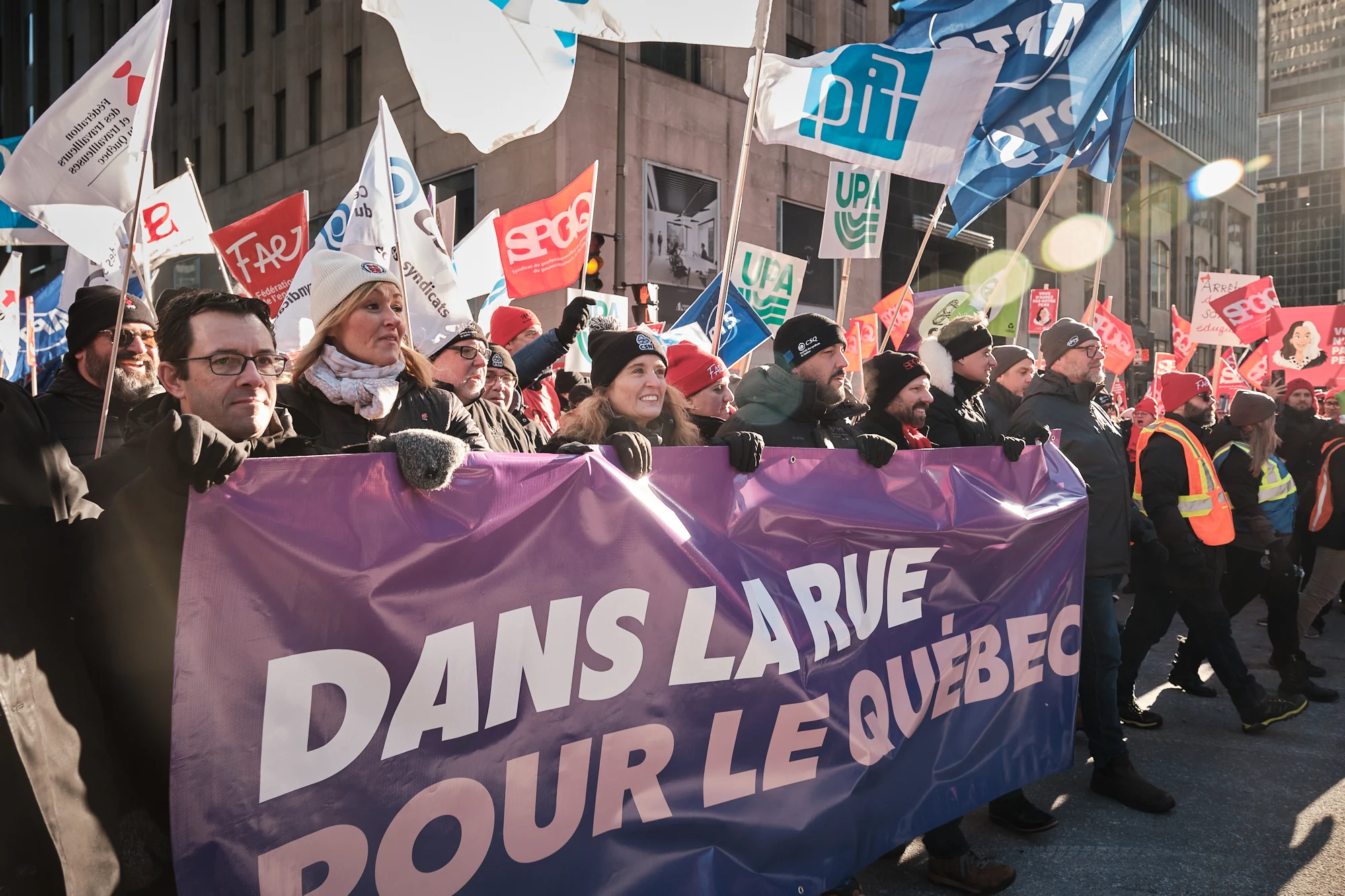
Photo Caption: Dans la rue pour le Québec, manifestation d’une alliance syndicale, Montréal, 25 novembre 2025
Photo Credit: Dominic Morissette



 Log in

